Surprise vs Suprise? Must-Know Difference Inside
The correct pronunciation and spellings are very important not only for learners but also for working people and English speakers. It is very important to keep in mind the proper form so that the writing content can be accurate and more authentic. In this article, you will learn about some tips so that you can clarify to yourself how to use or spell these two words, so read the full article below.
Surprise vs Suprise
Surprise in the form of Definitions
Noun
An unexpected event that occurred or happened.
Example:
His birthday party was a great surprise.
Verb
To astonish or amaze someone unaware.
Example:
They surprised him with a gift.
Adjective( drived)
Surprised or surprising.
What is the meaning of Surprise?
The word surprise is a noun and a verb, and in this word, there are two r’s and two s’s, and it means an unexpected event or the act by which someone gets amazed. It comes from Middle Englis,h and it means to overtake or to seize.
This word was borrowed from Anglo-French and Middle French and first used in the 15th century, and is used in many countries such as America, Britain and the English language.
The Etymology of “Surprise”
It is the nominal use of the past participle that is surprising, and it means overtake.
- Sore means over
- Prender means to take
It aligns with the influence of the French language on English vocabulary during the Norman conquest.
Concept of surprise in different books
There are some points in which this word is explained with some examples.
The Poetics of the Unexpected from Milton to Austen:
In this book, the word surprise is related to an unexpected change or twist that happened, and it was written by Christopher R. Miller and was published on April 10, 2015.
Embrace the Unpredictable and Engineer the Unexpected:
This book tells about the unexpected event that happened and how people deal with unhappiness, and it is written by Tania Luna and LeeAnn Renninger, PhD.
The Shape of My Early Life:
This book describes the life events of Lewis’s life and how surprising his journey is.it is published by C.S lewis in 1955.
Writing and Teaching for Surprise:
This book is about the students’ work that surprises teachers and was published by Donald M. Murray in 1984.
Surprise Me:
This book is all about the surprises between husband and wife and it is written by Sophie Kinsella.
Examples of the word surprise
- The fast growth of the country surprises us.
- She planned a surprise event for her husband.
- There are plenty of surprises for my friend.
- I love surprises.
- She spoiled the surprise.
Which one is Correct, “Surprise,” “Suprize”, or “Surprize”?
The correct word is surprise and the word surprise is used in past times, but nowadays it is used very rarely. and it resembles with surprise.
But the word surprise does not exist anywhere, and it is considered a wrong spelling so you should use correct spelling for content writing, and it becomes the form of present continuous tense when we place ing at the end of the word.
Impact of misspelling
Even small mistakes can hurt the credibility of the writing, it can also affect the ranking of the website and SEO. It causes a distraction for the reader,s due to which traffic is also affected.
How to Spell Suprise and Surprise” Correctly in Past Tense?
To make the form of the past tense, we place’d or ‘ed at the end of the word surprise and then it becomes surprised, and it is used mostly in American English and the part of the English Grammar rules.
Verb tenses are used in content writing so that information can be delivered properly.
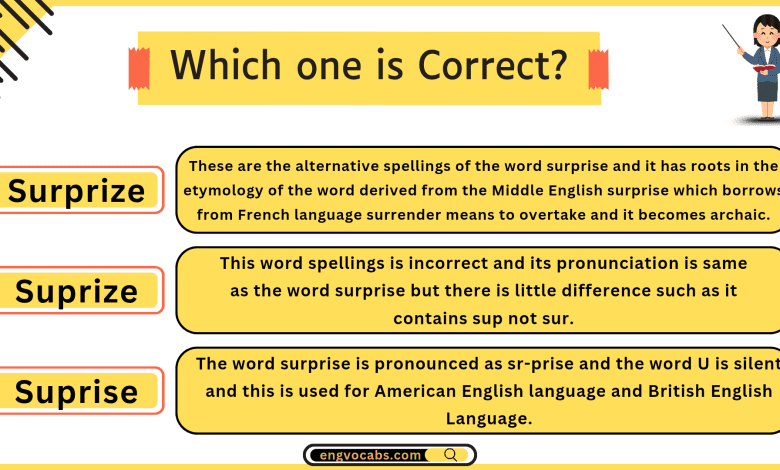
Surprise (historically accepted but now incorrect)
These are the alternative spellings of the word surprise, and it has roots in the etymology of the word derived from the Middle English surprise, which borrows from the French language surrender meaning to overtake and it becomes archaic.
How to Pronounce “Surprise”?
The word surprise is pronounced as sr-prise, and the word U is silent and which is used for American English and British English.
How to Pronounce “Suprise”?
This word spelling is incorrect, and its pronunciation is the same as the word surprise, but there is little difference, such as it contains sup, not sur.
What are the Other misspelt examples similar to “Surprise”, “Suprise”, and “Surprize”?
There is a list below in which these words are mentioned;
- Occurred, Ocurred, or Occurred
- Centre or Centre
- Until, Till, and Til
- Payed or Paid
- Labelled or Labelled
- Colour or Colour
- Purposely vs Purposefully
- Buses or Buses
- Happy New Year, New Year’s, or New Years
- Truly or Truely
- Moustache or Moustache
- Dragged or Drug
- Judgment or Judgment
Handy Tips to Avoid Confusion
Here are tips we can use to avoid confusion
Remember the Correct Spelling:
To remember the difference you should keep in mind that there are two Rs in correct spellings.
Use Spell Check Tools:
Use tools for a better writing experience such as MS Word, Google Docs, and Grammarly.
Regional Variations in Spelling Preferences
The word “surprise” is common in all English across all regions, but “surprise” and “suprise” have importance in historical and informal contexts.
British, Canadian and Australian have the same conventions, but to maintain clarity, it is very important to use the correct spellings in writing for the audience.
How Technology Shapes Spelling Trends
Technology influences modern spellings because it can harm and help spelling habits
Tools correct errors, but casual use may spread mistakes like “surprise.” Thoughtful use ensures clear, professional writing.
Conclusion
If we do more practice and use correct spellings, it will enhance our value of content writing; otherwise, it can create a bad impression for the audience and make our communication weak. The spelling mistakes matter a lot in the English language learning because if these are not correct, then the whole value of the meanings changes.
FAQs
Is the first R in surprise silent?
No, it is not. Silent it has full stress, and it means astonished at some condition that occurred, and people are fully amazed.
What is the difference between surprise and surprise?
Surprise means being amazed at anything that people can not even imagine it but the word surprise does not exist anywhere in English literature.
Is surprise spelt with az or an s?
Standard English spellings use s with spellings surprise because it means stunning which is not even in anyone’s mind.
Is the L silent in Calm?
L is a silent word, and it has no type of stress; the other three words have stress due to which the pronunciation happens.
What is the R-controlled vowel in surprise?
R is controlled by the word U.
Can surprise be spelt two ways?
No, there is only one way to spell the word surprise,e it contains two r’s and two s due to which it is pronounced.
Read More;